Reg. Charity No. 1168330

The Palaeontological Association was founded in 1957 and has become one of the world's leading learned societies in this field. The Association is a registered charity that promotes the study of palaeontology and its allied sciences through publication of original research and field guides, sponsorship of meetings and field excursions, provision of web resources and information and a program of annual awards.


The Palaeontological Association uses social media, as well as our website, to disseminate the latest news from the Association and wider afield.
The official Twitter account of the Palaeontological Association can be found by following this link: @ThePalAss. Most tweets by our Publicity Officer.
We also have an active PalAss facebook group.
Please follow us to keep up to date with palaeontologist related news.
If you wish to contact the Palaeontological Association, please do so using the form linked below.
The Palaeontological Assoication membership is open to anyone.
The Palaeontological Association was founded in 1957 to promote the study of palaeontology and its allied sciences and is governed and structured under rules and regulations set by the The Charity Commission.
Please consider donating to The Palaeontological Association: Your generosity will help to inspire future generations to investigate organisms of the past and to keep our discipline alive.
The Palaeontological Association publishes a variety of different publications throughout the year and possesses an extensive back archive of material.
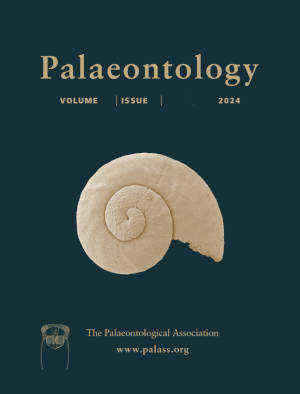
The journal Palaeontology is devoted to the publication of innovative and timely hypothesis-driven research that significantly advances understanding of the history of life on Earth.
Whilst the Palaeontological Association is developing a new website, please visit the page Member access to Association Journals to access any publications more recent than those shown below.
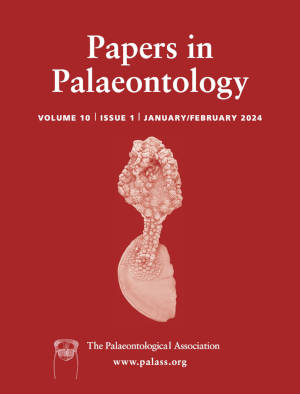
The journal Papers in Palaeontologyfocuses on descriptive research, including the descriptions of new taxa and of floras and faunas from specific localities or regions, systematic revisions, biostratigraphical and biogeographical documentation.
Whilst the Palaeontological Association is developing a new website, please visit the page Member access to Association Journals to access any publications more recent than those shown below.
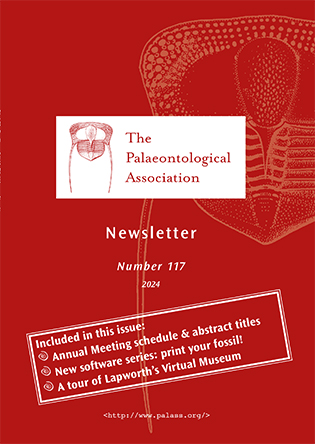
The Palaeontology Newsletter contains a mixture of palaeontological news, book reviews, reviews of past meetings, details of forthcoming meetings as well as a series of regular discussion features.
The Palaeontological Assocaition regually holds meetings and events aimed at both the scientific community and the general public.
The Progressive Palaeontology (ProgPal) meeting for postgraduate students is held annually, and run by students for students with the support of the Palaeontological Association.
Information on future meetings (excluding the Annual Meeting and Progressive Palaeontology) related to palaeontology.
To add a Future Meeting please use our online form: Add Future Meeting
The Palaeontological Association's Annual Meeting is the centrepiece of the Association's year.
The following Meeting Reports are available online, with many having appeared previously in the Palaeontological Association Newsletter.
The Palaeontological Association provides information on Undergraduate and Postgraduate (Masters and PhD) courses, as well as articles on possible career paths within palaeontology.
PhD projects currently on offer that we are aware of are listed under the PhD Opportunity section. Below are the latest notices added to our online database.
To add a PhD opportunity please use our online form: Add a PhD Opportunity.
These lists detail the Master courses that we are aware of. They are by no means exhaustive and the institutions listed, and others, may well be offering additional projects. Further details for many of these projects are available on institutional website. Note that application deadlines can be as early as January, and interviews usually take place during the period January-April.